- Sujnana Samriddhi Sukshema - CBSE Affiliation No. 830975
- 08395 - 260477
- 094826 84477
- info@bkgglobalschool.com


Importance of Early Childhood Education in Child Development

How Nursery School Helps Children Develop Confidence and Creativity
April 29, 2026
Top 10 Practical Life Skills Every Student Should Learn Early
May 22, 2026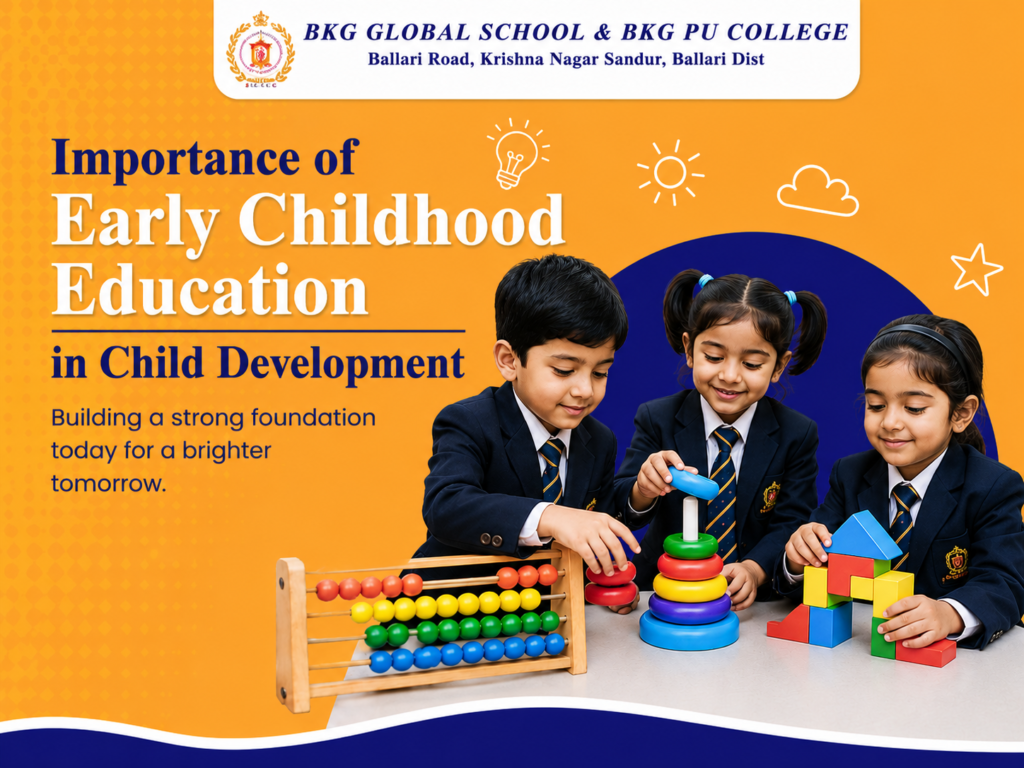
According to the research, by the time your child turns six, nearly 90% of their brain development is already done. These are the crucial years of their life when the connections that shape how they think, feel, relate to others, and handle challenges are being built right now, whether you plan for it or not.
That’s why choosing the right nursery school in Sandur or early years school in Sandur is not a small decision. It’s one of the most important things you’ll do as a parent. All this understanding regarding what early childhood education actually does, not in theory, but in real, everyday ways that show up in your child’s life for decades.
What Early Childhood Education Actually Is
Early childhood education is not about just learning the alphabet to three-year-olds or getting a head start on homework. It’s about creating the right conditions for a child’s brain to develop the way it’s meant to.
Early childhood education in Sandur, like anywhere else, covers the foundational years from birth to about age eight. During this time, children are not just learning facts but also learning how to learn, how to pay attention to the things that are happening around them. How to get along with others. How to manage frustration. How to be curious without being afraid of getting things wrong.
These are not soft skills. They are the skills everything else is built on.
What Actually Develops in the Early Years
Thinking and Problem-Solving
Young children are natural scientists. They test things, observe what happens, and adjust. A good early years environment gives them space to do exactly that with building blocks, water play, puzzles, and open-ended questions from teachers who know when to step in and when to step back.
Language and Communication
Children who are spoken to often, read to regularly, and asked real questions develop stronger vocabularies and develop communication skills. This matters because language ability at age five is one of the strongest predictors of reading ability at age ten. Early childhood education in Sandur that puts language at the centre is doing something genuinely valuable.
Emotional Regulation
This point mainly neglects many of the parents, a child who can identify what they’re feeling, handle disappointment without falling apart, and empathise with a friend who is upset, that child will navigate school, relationships, and adult life better than one who simply knows more facts. The best nursery school in Sandur builds this quietly, consistently, through daily interactions.
Social Development
Learning to share, take turns, disagree without aggression, and make friends, these things don’t happen automatically. They need to be practised in a safe environment, with guidance from adults who understand child development. That’s exactly what a well-run early years school in Sandur provides.
Physical Development
Fine motor skills like holding a pencil, cutting with scissors, and fastening buttons. Gross motor skills like running, jumping, and balancing. Both matter, and both develop when they do by their own, active play that good early childhood programmes are built around.
What Makes a Good Early Years School in Sandur
Not every school that calls itself a nursery delivers what children actually need. Here’s what to look for.
Teachers Who Understand Children, Not Just Content
Teachers play an important role more than almost anything else. A teacher who understands the child’s level of learning, follows their curiosity, and knows how to challenge without overwhelming, gently, that person is shaping the brain of every child in that room. When you visit a nursery school in Sandur, watch the teachers more than the facilities.
A Curriculum That Has Room to Breathe
Structure matters. So does freedom. The best programmes have a clear shape to the day without every minute being controlled. Children need time to choose their own activities, pursue their own interests, and figure things out without being immediately corrected. That’s not wasted time. That’s learning.
Parents in the Picture
What happens at school and what happens at home need to be connected. An early years school in Sandur worth its salt will communicate openly with parents, invite them in, and give them practical ways to support their child’s development at home. Learning doesn’t stop when the school bag comes off.
The Long-Term Picture
Children who attend quality early childhood programmes don’t just do better in primary school. They tend to stay in school longer, find more stable work, and report better mental health as adults. The effects are not marginal. They are significant and lasting.
What this really means is the investment you make in early childhood education in Sandur when your child is three pays returns when they are thirty. That’s not an exaggeration. That’s what the research consistently shows.
Conclusion
Your child will not remember everything that they have done or every song they have listened to, but their brain will carry the shape of those experiences for life. Whether you are looking at a nursery school in Sandur for a two-year-old or an early years school in Sandur for a child about to start primary, the question that is important while you are choosing is whether this place genuinely understands your children.
If the answer is yes, it means you are in the right place. So, start early, stay involved, and trust that those small moments are building something that lasts.
Frequently Asked Questions
Q1. What’s the difference between a nursery school and an early years school in Sandur?
A nursery school mainly focuses on the 2 to 4-year-old age group, with an emphasis on play and social development. An early years school in Sandur typically covers a wider age range, up to around six years, and consists of a more structured approach to early literacy and numeracy, alongside the different play-based elements to build new skills.
Q2. Can’t I just wait until my child starts formal school?
You can. But the brain doesn’t wait. The years before formal school are when the foundations for language, emotional regulation, and social behaviour are laid. Children who miss quality early education often spend the early primary years catching up on things that could have developed naturally earlier.
Q3. How do I know if a nursery school in Sandur is actually good?
Visit in person. Watch how the teachers interact with children. Talk with teachers and existing children, ask about the daily routine, how they handle difficult behaviour, and how they communicate with parents. Trust your instincts once you’ve seen it with your own eyes.
Q4. What can I do at home to support what my child learns at school?
Interact with your child every day. Have real conversations, not just pass instructions, and ask about their choices. Play with them, and help them learn new things. Ask their teachers what they’re working on and build small moments around it at home. Consistency between school and home makes a genuine difference.
Q5. What kind of curriculum do early childhood schools in Sandur usually follow?
Many follow the National Curriculum Framework for the Foundational Stage, which emphasises play-based and activity-led learning. Some schools also draw from Montessori principles or thematic learning approaches. The best programmes, regardless of the framework, put the child’s natural development at the centre of everything they do.