- Sujnana Samriddhi Sukshema - CBSE Affiliation No. 830975
- 08395 - 260477
- 094826 84477
- info@bkgglobalschool.com


Top 10 Practical Life Skills Every Student Should Learn Early

Importance of Early Childhood Education in Child Development
May 21, 2026
How CBSE Education Supports Competitive Exam Preparation
June 23, 2026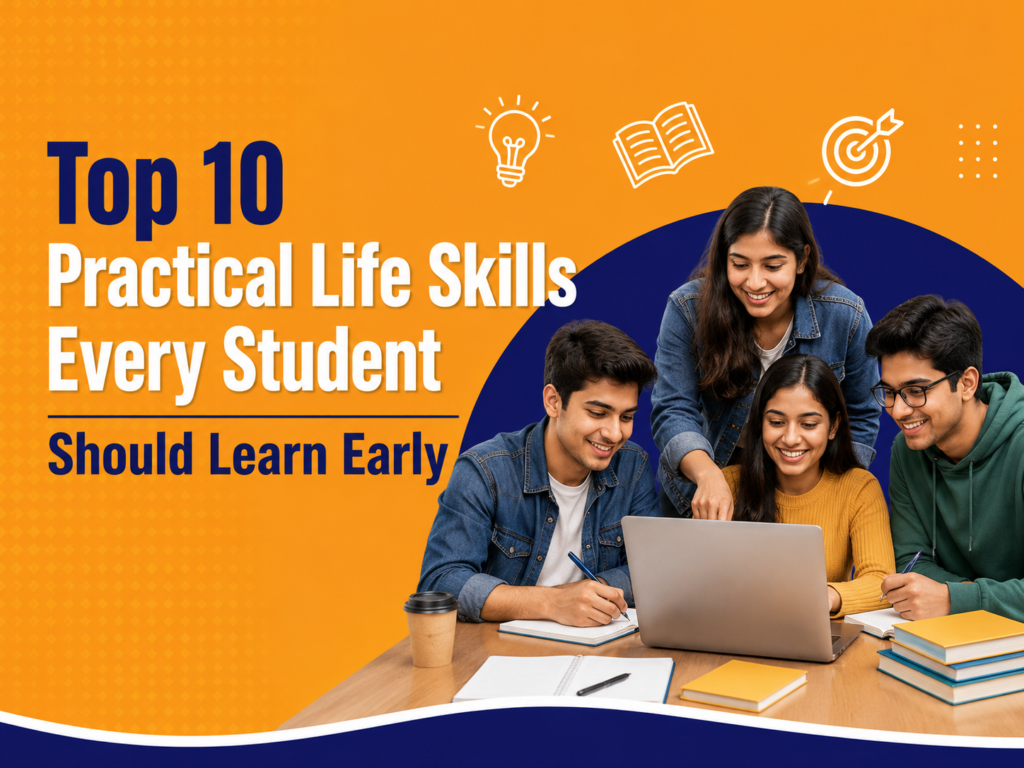
Ask any working adult what they wish school had taught them, and the answers are rarely algebra or essay structure. They say things like how to handle money, how to deal with difficult people, and how to pick themselves up after failing at something.
Schools are good at teaching content. They are often not great at teaching students how actually to use their lives.
That is starting to change. Parents and educators who believe in holistic education in CBSE schools in Sandur are pushing for a more complete school experience that prepares kids for real-world situations, not just exam halls. And the best time to start? Early. Much earlier than most people think.
Here are 10 practical life skills every student should learn before leaving middle school.
1. How to Communicate Clearly
Not Just Talking; Actually Being Understood
There is a big difference between speaking and communicating. A student who can explain an idea, disagree without being rude, and ask for help without anxiety is miles ahead of one who cannot. These skills do not appear on their own. They need to be practiced in classrooms, in group discussions, and in everyday situations.
Any quality middle school education worth its name should deliberately build this, not leave it to chance.
2. Time Management
The Habit That Changes Everything
Here is the thing about time: children have no instinct for managing it. They have to be taught. And the earlier they learn to plan, prioritize, and follow through, the more control they feel over their own lives.
This is not about pressuring them to follow schedules. It is about teaching kids that time choices are about what matters to them.
3. Critical Thinking
Teaching Kids to Question, Not Just Answer
Memorizing facts is easy, but knowing what to do with them is the hard part. Critical thinking is the ability to slow down, look at a problem from different angles, and make a decision that actually makes sense.
Schools that practise this approach well do not just hand students answers. They also hand them situations and ask for their opinions. Foundation schools in Sandur that build this habit early are giving students a real advantage, not just academically but in every decision they will face later.
4. Financial Literacy
Money Is Not a Taboo Subject
Most adults learn about money through mistakes. Kids don’t have to. Teach them early that money runs out, choices cost something, and saving now beats regretting later.
5. Emotional Intelligence
Knowing Yourself Is a Skill, Not a Personality Trait
Students who can understand what they are feeling, manage it, and recognize what others might be going through find it easy to build better friendships, handle pressure more effectively, and grow into adults people actually want to work with.
Holistic education in CBSE schools in Sandur treats emotional development as seriously as academic development. That is the right call.
6. Digital Literacy
Being Online Is Not the Same as Being Smart Online
Children are online constantly, but they often lack judgment about how to spot misinformation, avoid content that is not for them, protect their privacy, and use technology as a tool rather than letting it use them. Misuse of online applications leads to so many problems and scams. Digital literacy is not a tech class. It is a thinking class. And it belongs in every school curriculum.
7. Teamwork
Working With People You Did Not Choose
Group projects are frustrating. That is partly the point. Real life involves working with people who think, communicate, and approach problems differently. Learning to navigate that without shutting down or taking over is one of the most useful things a student can practice.
8. Resilience
Falling and Getting Back Up Without Drama
Failure is not the enemy; it teaches you how to learn from it and apply it further. Students who are taught that setbacks are normal, that effort matters more than outcome, and that trying again is a sign of strength rather than weakness handle life better. A quality middle school education should make space for struggle, not just success.
9. Basic Health and Self-Care
Taking Care of Yourself Is a Responsibility
Sleep, food, movement, and hygiene always sound obvious and require responsibility, but surprisingly, very few people do them on their own, or someone helps them. It is simple to understand that when students understand how their choices affect their energy, focus, and mood, they make better choices.
10. Goal Setting
Knowing Where You Want to Go
Not every child needs a five-year plan. But every child should know how to set a small goal, break it into steps, and work toward it. That process of deciding what you want and moving toward it is the foundation of motivation. No external reward needed.
Foundation schools in Sandur that teach this well are not just producing better students; they are also fostering a culture of learning. They are producing people who know how to go after things.
Conclusion
Exams test what a student knows. Life tests how they think, feel, manage themselves, and treat others.
Schools that take both seriously are doing something important. If you are looking for a school that pairs strong academics with this kind of deliberate, practical education, look for one built around holistic education where quality middle school education means preparing kids for the whole of their lives, not just the next test.
That is what the best foundation schools in Sandur are working toward. And it is worth looking for.
Frequently Asked Questions
Q1. Are life skills really the school’s job, or should parents handle this?
Both. Schools have the structure and the peer environment to practice skills like teamwork, communication, and resilience in ways that home cannot always replicate. When schools and parents work on this together, the results are far better than either doing it alone.
Q2. What is the right age to start teaching these skills?
Emotional regulation and basic communication should be taught in preschool from an early age. Goal setting and financial basics fit naturally into middle school. The key is that the lessons match where the child actually is, not where we think they should be.
Q3. How does holistic education in CBSE schools in Sandur approach life skills?
Schools with a genuine commitment to holistic education weave these skills into daily school life through how they structure group work and how teachers respond to failure through sports, arts, and community activities. It is not a separate subject. It shows up in how the whole school is run.
Q4. How can parents support this at home?
Give children responsibilities that matter and are needed more every time. Let them fail at small things and learn from those mistakes. Have real conversations about money, relationships, and decisions so they will also understand the value of it. Model the skills yourself. Children learn far more from watching than from being told.
Q5. What separates a foundation school in Sandur from a standard school?
A good foundation school is not just focused on early academics. It is focused on building the habits, attitudes, and skills that will serve a child throughout every stage of life, from the very beginning of their education.